


What Is Inside a Clean Energy Product

Professional buyers usually compare photovoltaic modules by power, price, guarantee and expected yield. Those factors matter, but they do not answer a growing procurement question: what materials will remain on the roof for the next 25 or 30 years, and what happens to them afterwards?
A module can produce low-carbon electricity for decades while its own material choices create avoidable concerns in manufacturing or at the end of its service life. Sustainable procurement should therefore evaluate the product as carefully as the energy it produces.
Material Choice Belongs in the Specification
PFAS are a broad family of synthetic chemicals valued for their resistance to heat, weathering and chemicals. Their persistence in the environment has brought them under increasing regulatory and procurement scrutiny in Europe.
Solar modules are long-life industrial products. Their material composition can affect supply-chain requirements, future compliance reviews and end-of-life options. Calling a module green because it generates renewable electricity does not answer those questions. The claim needs product-level evidence.
Three Documents That Make Sustainability Comparable
Before approving a module, ask the supplier for three specific forms of evidence:
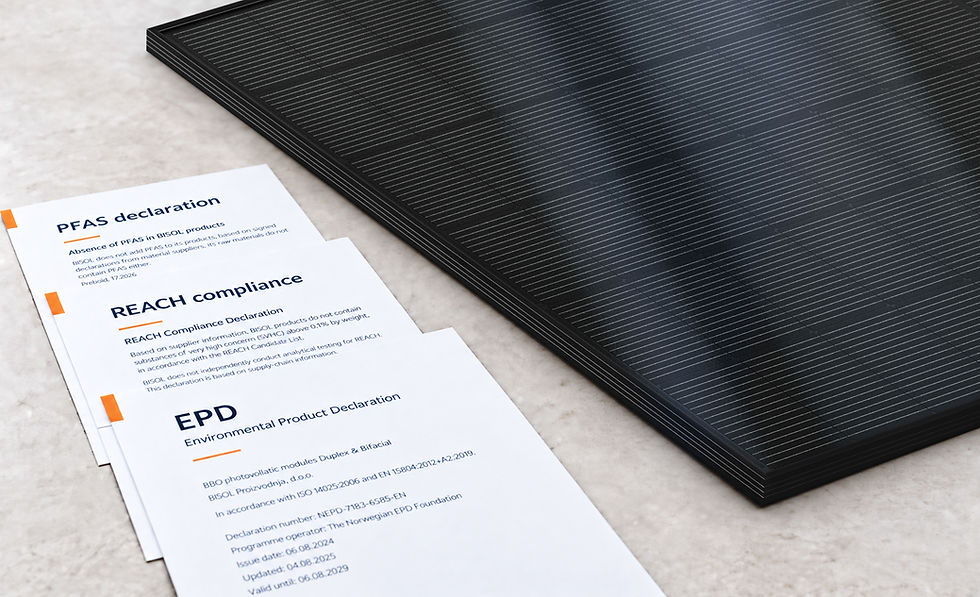
PFAS declaration. Does the manufacturer explicitly confirm the PFAS status of the relevant product family?
REACH compliance. Does the product comply with the EU chemical requirements currently applicable to it?
Environmental Product Declaration. Has its environmental impact been documented using a standardised method and independently verified?
These documents answer different questions. A PFAS declaration addresses a defined material concern. REACH compliance addresses chemical obligations. An Environmental Product Declaration, or EPD, reports lifecycle impacts; it does not claim that a product has no environmental footprint. Together, the three turn broad sustainability language into evidence a procurement file can use.
Evidence Belongs in the Procurement File
For procurement teams, the availability of these documents matters as much as their content. If a tender, financier or corporate customer asks for material and lifecycle evidence after the module has been selected, missing documentation can slow approval or force a late product change.
Requesting it before specification keeps sustainability criteria comparable and gives the buyer a defensible record of why the product was accepted.
How BISOL Supports the Check
BISOL states that all its photovoltaic modules are PFAS-free and that all its products comply with REACH. The company also publishes third-party-verified EPDs for specified module families, enabling buyers to review standardised lifecycle information instead of relying on a general environmental claim.
BISOL develops and manufactures its modules in the European Union. This gives the company direct oversight of product design, supplier selection and production, and creates a clearer link between the environmental requirement in a specification and the evidence delivered with the product.
Clean Energy Starts Before Commissioning
A kilowatt-hour describes what a module produces. It does not describe everything the module contains.
The stronger procurement question is whether the supplier can document both.


